
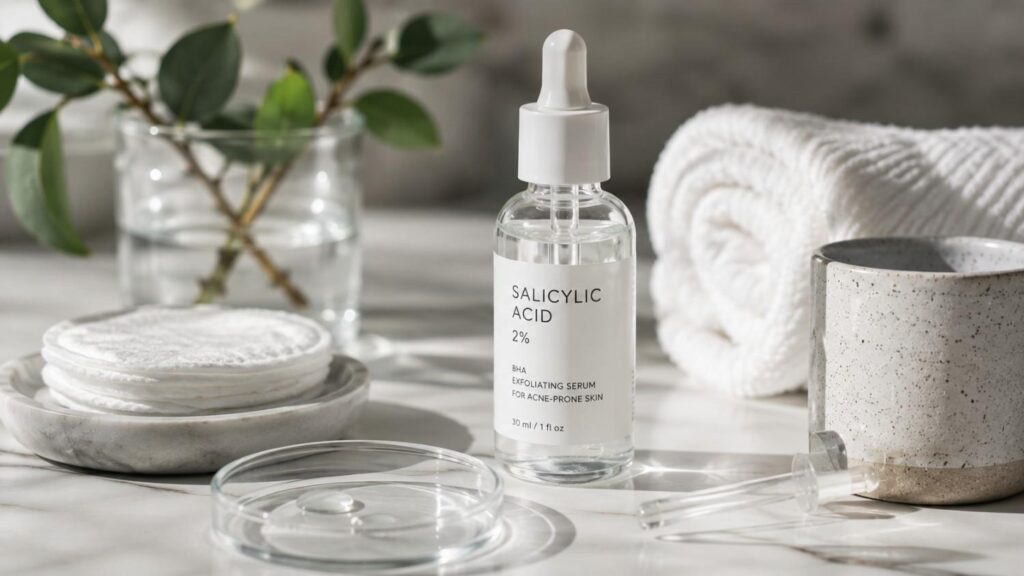
The Benefits of Salicylic Acid for Acne: A Clear Guide
Salicylic acid is one of the most widely recognized ingredients in over-the-counter acne care. It appears in face washes, gels, medicated pads, liquids, moisturizers, and leave-on exfoliating treatments. Its popularity is not based only on marketing. Dermatology guidance identifies salicylic acid as a topical option that can exfoliate the skin and help open clogged pores.
To understand why this ingredient can help, it is useful to know how acne begins. A pore is the opening of a hair follicle. Oil called sebum normally travels through the follicle to the skin’s surface. When oil and skin cells collect inside the follicle instead, a plug can form. That blockage may develop into a whitehead, blackhead, or inflamed pimple.
The benefits of salicylic acid for acne are usually clearest when breakouts involve congestion near the skin’s surface. This includes blackheads, whiteheads, small clogged bumps, oily areas, and some mild pimples. The American Academy of Dermatology specifically notes that salicylic acid opens clogged pores and exfoliates the skin. Current AAD acne guidelines include it as a conditionally recommended topical therapy, meaning that it can be useful but individual factors still affect whether it is the right choice.
Salicylic acid is not a universal solution. A person with occasional blackheads may need a very different treatment plan from someone with painful nodules, hormonal acne, widespread inflammation, or permanent scarring. Successful acne care depends on matching the treatment to the type of breakout, using it consistently, and avoiding routines that damage the skin barrier.
This article explains how salicylic acid works, which types of acne may respond, how to choose an appropriate product, and how to minimize irritation. It is general educational information rather than a medical diagnosis or a substitute for personalized care from a qualified healthcare professional.
What Is Salicylic Acid and How Does It Work?
Salicylic acid is a topical keratolytic medication. A keratolytic agent helps loosen and remove built-up skin cells. In cosmetic skincare, salicylic acid is also commonly classified as a beta hydroxy acid, usually shortened to BHA. These terms may sound technical, but the practical purpose is straightforward: the ingredient helps reduce the cellular buildup that contributes to rough skin and blocked follicles.
Acne does not develop simply because the skin is “dirty.” Hair follicles can become blocked when sebum and skin cells remain trapped rather than moving normally toward the skin’s surface. Bacteria that naturally live on the skin may then multiply inside the blocked follicle, contributing to redness, swelling, tenderness, or pus-filled lesions.
Salicylic acid addresses one important part of this process by exfoliating accumulated cells and helping open clogged pores. It may also reduce redness and swelling around some blemishes. However, acne has several possible contributing factors, including excess oil, abnormal skin-cell shedding, inflammation, bacteria, hormones, medications, and genetic tendency. This is why one ingredient may improve certain lesions without controlling every breakout.
Understanding this mechanism helps set realistic expectations. Salicylic acid is usually most useful for congestion and mild surface-level acne. It may support a wider routine, but it should not automatically replace treatments designed for moderate, severe, hormonal, or deeply inflammatory acne.
If you want a broader explanation of how beta hydroxy acids function in everyday skincare, this BHA skincare guide from Healthline provides additional background that complements the information discussed here.
It Removes Built-Up Dead Skin Cells
The skin continually produces new cells and sheds older ones. Under normal conditions, these cells move toward the surface and separate without creating a noticeable problem. In acne-prone skin, however, skin cells may remain within a follicle and mix with sebum. This sticky combination can contribute to the formation of a comedone, which is the medical term for a clogged pore.
Salicylic acid acts as a keratolytic agent, meaning that it helps soften and loosen built-up cells. This controlled chemical exfoliation is different from scrubbing with rough particles, brushes, or abrasive cloths. Physical scrubbing relies on friction, while salicylic acid changes how compacted surface cells separate. MedlinePlus explains that salicylic acid treats scaling conditions by loosening thickened or dry skin and treats acne by unplugging blocked pores.
Removing excessive buildup may make congested skin feel smoother and reduce the conditions that allow whiteheads or blackheads to form. More exfoliation is not always better, however. Applying the product too often may cause dryness, burning, or irritation. Effective use means removing unnecessary buildup without repeatedly stripping the skin.
It Helps Unclog Hair Follicles
A hair follicle is a small channel in the skin connected to a sebaceous gland. That gland produces sebum, an oily substance that helps protect the skin from becoming excessively dry. Acne can develop when sebum and skin cells remain trapped inside the follicle rather than reaching the surface normally.
A closed blockage produces a whitehead. When the blocked follicle remains open at the surface, it forms a blackhead. The dark appearance of a blackhead does not mean that dirt is trapped inside it. The National Institute of Arthritis and Musculoskeletal and Skin Diseases explains that the material appears dark because exposure to air changes the color of the sebum.
Salicylic acid helps loosen the material contributing to these blockages. It does not extract a comedone immediately, and a single application will not permanently prevent clogged pores. Instead, regular use may gradually reduce existing congestion and make it harder for new plugs to build up. This makes the ingredient especially relevant for people who repeatedly develop blackheads or whiteheads in the same areas.
It Can Reduce Swelling and Redness
Acne is not only a problem of blocked pores. It is also an inflammatory skin condition. When a clogged follicle becomes inflamed, the surrounding skin may appear red, swollen, warm, or tender. Papules look like small raised bumps, while pustules are inflamed lesions containing visible pus.
MedlinePlus states that topical salicylic acid treats acne partly by reducing swelling and redness while unplugging blocked pores. This means its usefulness is not limited entirely to non-inflamed blackheads and whiteheads. Some people may also notice improvement in small, mildly inflamed pimples, especially when clogged pores are part of the problem.
However, the ingredient should not be described as a complete anti-inflammatory treatment for all acne. Large nodules and cysts form deeper within the skin and can remain painful for an extended period. A surface treatment may offer limited help once inflammation extends far below the follicle opening. Salicylic acid is therefore better viewed as one targeted tool rather than a cure. Persistent, deep, painful, or scarring lesions should be assessed by a dermatologist.
Key Benefits of Salicylic Acid for Acne
The most important salicylic acid benefits relate to pore congestion. It can help remove accumulated skin cells, keep follicles clearer, reduce certain mild blemishes, and support a smoother-looking skin surface. These effects make it useful for people whose acne appears mainly as blackheads, whiteheads, small bumps, and occasional surface-level pimples.
Its availability is another practical advantage. Salicylic acid can be found in several formats and strengths, allowing users to choose between a short-contact cleanser and a leave-on treatment. This flexibility can help beginners find a routine that suits their tolerance. In the United States, products marketed as over-the-counter acne drugs may contain salicylic acid within the federally specified concentration range of 0.5% to 2%.
The ingredient also fits into preventive acne care. Acne treatment is often more effective when it addresses the affected area consistently rather than reacting only after a large pimple appears. Keeping follicles clearer may reduce the development of future comedones and blemishes, although the outcome varies between individuals.
These advantages should be balanced against its limitations. Salicylic acid may not address hormonal drivers, severe inflammation, deep lesions, or established structural scars. It can also irritate dry or sensitive skin. The strongest routine is not the one containing the most active ingredients; it is the one that targets the person’s acne while remaining tolerable enough for consistent use.
It Works Well for Blackheads and Whiteheads
Blackheads and whiteheads are forms of comedonal acne. Both begin with a blocked hair follicle, but they look different because one remains open at the surface while the other stays closed. Since salicylic acid helps exfoliate the skin and clear pore blockages, it is especially relevant for these non-inflammatory blemishes.
The American Academy of Dermatology states that salicylic acid works best on whiteheads and blackheads because it unclogs pores and exfoliates the skin. This makes it a practical option for congestion on the nose, forehead, chin, chest, shoulders, or back, provided that the product is intended for the chosen body area.
Results are usually gradual rather than immediate. A blackhead is not simply surface dirt that can be dissolved in a few minutes. The blockage forms within a follicle and may require repeated, consistent treatment. Picking, squeezing, or using metal extraction tools without proper technique may increase inflammation, discoloration, or scarring. Salicylic acid offers a less aggressive approach by addressing the buildup over time. People with many persistent comedones may still need a retinoid or professional treatment plan.
It May Help Prevent New Clogged Pores
A visible blemish is often the final stage of a process that began earlier inside the follicle. Treating only the largest pimple may leave smaller developing blockages unaddressed. Salicylic acid can support prevention by reducing the skin-cell buildup that contributes to new comedones.
MedlinePlus states that topical salicylic acid is used to help clear and prevent pimples and skin blemishes. U.S. acne-product regulations also recognize claims related to reducing acne blemishes, blackheads, and whiteheads when products meet the relevant requirements.
This preventive role explains why many acne treatments are applied to the full acne-prone area rather than directly to one visible spot. The correct approach still depends on the label. A cleanser may be used across the face and rinsed away, while a concentrated leave-on product may require a thin layer over a smaller affected zone.
Prevention does not mean that breakouts will never occur. Hormones, stress, medications, hair products, friction, and other factors may still contribute. Consistent pore care can reduce one important trigger, but it does not remove every possible cause of acne.
It Can Support Smoother-Looking Skin
Congested skin may feel rough because of small clogged pores and accumulated surface cells. By loosening this buildup, salicylic acid can help the skin feel smoother and appear more even. This cosmetic improvement may be especially noticeable when roughness is caused by numerous tiny comedones rather than deep inflammation.
The effect should not be confused with permanent pore reduction. Pores are normal anatomical openings, and no topical product can erase them. When oil and cellular debris are reduced, however, the openings may appear less noticeable because they are not as congested. The goal is clearer-looking pores rather than “poreless” skin.
It is also important to distinguish rough texture from true acne scarring. Flat dark or red areas left after a breakout are often post-inflammatory color changes rather than scars. Depressed and raised scars involve changes in collagen and skin structure. The AAD explains that depressed scars, raised scars, and flat post-acne marks are different concerns and may require different treatments.
Ordinary salicylic acid skincare may improve temporary roughness, but it should not be promoted as a complete treatment for deep, raised, or established acne scars.
Related Articles
Which Types of Acne Respond Best?
The effectiveness of an acne ingredient depends on the type of lesion being treated. Salicylic acid is most closely matched to comedonal acne, which includes blackheads, whiteheads, and small clogged bumps. It may also assist with a limited number of mild papules or pustules, particularly when congestion is present.
This ingredient is less likely to control acne driven mainly by deep inflammation, hormones, or widespread disease. Nodules and cysts extend further into the skin and carry a greater risk of permanent scarring. Moderate or severe acne may require prescription topical medication, oral medication, hormonal treatment, or a combination selected by a dermatologist.
Correctly identifying the lesion type can prevent months of ineffective self-treatment. A person may describe every bump as a “pimple,” but blackheads, papules, pustules, nodules, cysts, ingrown hairs, folliculitis, and rosacea do not necessarily respond to the same products.
Location also matters. Facial acne may tolerate a different product from chest or back acne. Sensitive areas around the eyes, lips, nostrils, and broken skin should not be treated casually with concentrated exfoliating products.
A reasonable home routine is most appropriate for mild acne. Early professional help is preferable when breakouts are painful, rapidly worsening, causing dark marks or scars, or affecting emotional well-being. Treating inflammatory acne early can reduce the chance that deeper lesions will leave lasting changes.
Mild Comedonal Acne
Mild comedonal acne usually appears as scattered blackheads, whiteheads, and small flesh-colored bumps. These lesions result from material collecting inside a hair follicle without the deep inflammation seen in nodules or cysts. Because salicylic acid directly supports exfoliation and pore clearing, this is the acne pattern most closely aligned with its mechanism.
A cleanser may be enough for occasional congestion, while persistent comedones may respond better to a carefully introduced leave-on formula. Product strength alone does not determine effectiveness. Contact time, frequency, the full formulation, and the person’s skin tolerance also influence the result.
Someone with dry or sensitive skin may obtain better results from a lower-strength or rinse-off product used consistently than from a strong liquid that causes ongoing peeling. A damaged skin barrier can make the face feel tight, sore, and reactive, which may lead the user to abandon treatment.
Salicylic acid is not the only option for comedonal acne. Topical retinoids such as adapalene are strongly recommended in current dermatology guidance and may provide broader prevention. A clinician can help compare the likely benefit, irritation risk, pregnancy considerations, and overall routine.
Small Pimples and Occasional Breakouts
Salicylic acid may help when acne consists of a few small pimples alongside oily or congested areas. The AAD includes a salicylic acid face wash among possible options for papules, which are small inflamed bumps. MedlinePlus also notes that the ingredient can reduce swelling and redness while clearing blocked pores.
This does not mean that every red pimple will respond equally. A small surface-level lesion may improve as the blockage clears, while a larger inflamed blemish may respond better to benzoyl peroxide or another acne treatment. Treatment choice should reflect the overall pattern rather than one isolated spot.
For occasional breakouts, consistency remains more useful than aggressive spot treatment. Applying several acids, drying lotions, scrubs, and patches at the same time can make a blemish look more inflamed. A simple routine with gentle cleansing, one acne treatment, moisturizer, and sunscreen is easier to evaluate.
People should also avoid squeezing small pimples. Manipulation can push inflammation further into the skin, increase healing time, and raise the risk of discoloration or scarring.
Deep, Painful or Scarring Acne
Nodules and cysts develop deeper within the skin than ordinary blackheads or whiteheads. These lesions may feel firm, tender, or painful and can remain for weeks. Because the inflammation extends below the surface, an over-the-counter salicylic acid cleanser is unlikely to provide complete control on its own.
Deep acne also carries a greater risk of depressed, raised, or discolored marks after healing. Repeatedly trying stronger exfoliants may delay effective treatment while increasing irritation. The AAD recommends professional care for severe acne and identifies isotretinoin as an option for severe cases or acne that has not responded to standard topical or oral therapy.
A dermatologist may use combinations that address several acne pathways at once. Depending on the individual, these may include topical retinoids, benzoyl peroxide, azelaic acid, antibiotics, hormonal therapies, or other prescription treatments.
Prompt care is particularly important when acne is already leaving indentations, thickened scars, or persistent discoloration. Salicylic acid may remain part of a supporting routine, but it should not be treated as the central solution. Professional assessment can also rule out conditions that resemble acne but require a different approach.
| Acne Type | Pore Condition | Salicylic Acid Suitability | Additional Care May Be Needed |
|---|---|---|---|
| Blackheads | Open clogged pores | High | Gentle cleansing and moisturizer |
| Whiteheads | Closed clogged pores | High | Consistent skincare routine |
| Mild Comedonal Acne | Blocked follicles | High | Daily maintenance routine |
| Small Pimples | Mild inflammation | Moderate | Combine with suitable acne routine |
| Oily Skin Breakouts | Excess sebum | High | Oil-control skincare products |
| Nodular or Cystic Acne | Deep inflammation | Low | Dermatologist evaluation recommended |
How to Use Salicylic Acid Safely
Safe use begins with reading the label rather than relying on a general social media routine. Salicylic acid products vary in strength, vehicle, contact time, and intended frequency. A face wash that remains on the skin briefly is not used in the same way as a leave-on gel or medicated pad.
MedlinePlus advises using topical salicylic acid exactly as directed and not applying more of it, using it more often, or covering a larger area than instructed. New users are advised to test a small amount on one or two affected areas for three days before beginning full use.
A cautious routine is especially important for dry, sensitive, eczema-prone, or previously irritated skin. Mild tingling may occur with some products, but persistent burning, pronounced redness, swelling, or painful peeling should not be ignored.
Other products in the routine also matter. Strong cleansers, alcohol-heavy toners, physical scrubs, retinoids, benzoyl peroxide, sulfur, and additional exfoliating acids may increase irritation when layered without a plan. This does not mean these ingredients can never be combined. Dermatologists often use combination treatment because acne has several causes. The combination must simply be introduced in a way the skin can tolerate.
The objective is steady improvement, not maximum exfoliation. A routine that can be followed consistently is usually more useful than an aggressive routine that repeatedly damages the skin barrier.
| Salicylic Acid Format | Best For | Skin Type | Main Benefit | Frequency Consideration |
|---|---|---|---|---|
| Cleanser | Daily pore cleansing | Oily to combination | Removes excess oil and surface buildup | Can be used regularly if tolerated |
| Leave-on Serum | Persistent blackheads and whiteheads | Acne-prone | Longer contact time for clogged pores | Introduce gradually to reduce irritation |
| Gel Treatment | Mild acne breakouts | Oily skin | Targets congested areas | Avoid overapplication |
| Medicated Pads | Chest and back acne | Normal to oily | Convenient body application | Use gently to prevent irritation |
| Moisturizer with Salicylic Acid | Combination skin | Combination to dry | Hydration with mild exfoliation | Check for additional active ingredients |
Choose the Right Product Format
Salicylic acid cleansers are often a practical starting point because they are rinsed away. Their shorter contact time may reduce irritation, although this depends on the full formulation and frequency. They may suit oily skin, mild facial congestion, or acne affecting larger areas such as the chest and back.
Leave-on liquids, gels, serums, and medicated pads remain on the skin longer. This may provide more direct treatment for persistent blackheads and whiteheads, but it also increases the importance of careful frequency and moisturizing. Pads are convenient, yet rubbing them firmly across the skin can add unnecessary friction.
Moisturizers containing salicylic acid combine treatment with hydration, but users should still check whether the formula contains other active ingredients. Multiple acids hidden across a cleanser, toner, serum, and cream can create accidental over-exfoliation.
In the United States, over-the-counter topical acne drug products may contain 0.5% to 2% salicylic acid. This range does not apply to every cosmetic or professional product worldwide, and 2% is not automatically the best concentration for everyone. Strength should be considered alongside format, frequency, treatment area, and skin tolerance.
For readers comparing cleansers, gels, and leave-on treatments, this salicylic acid skincare routine offers practical examples of how different product formats can fit into an acne-care regimen without replacing professional medical advice.
| Product format | May suit | Main consideration |
|---|---|---|
| Salicylic acid cleanser | Beginners, oily skin, or widespread mild congestion | Shorter contact time because it is rinsed off |
| Leave-on gel or liquid | Persistent blackheads and whiteheads | Greater risk of dryness when overused |
| Medicated pads | Convenient use or selected body areas | Friction and repeated wiping may irritate |
| Salicylic acid moisturizer | Combination or acne-prone skin needing hydration | Check for additional active ingredients |
| Professional chemical peel | Selected acne, discoloration, or texture concerns | Requires appropriate professional assessment |
Follow a Simple Starter Routine
Begin by patch testing according to the product instructions. MedlinePlus advises placing a small amount on one or two affected areas for three days when using topical salicylic acid for the first time. Stop if a concerning reaction develops.
For a rinse-off cleanser, wet the skin, massage the product gently for the time stated on the label, rinse thoroughly, and pat dry. Do not scrub with a brush or rough cloth. For a leave-on product, apply a thin, even amount to clean skin as instructed. More product does not force the pores to clear faster.
A simple beginner routine may include:
- A gentle cleanser or salicylic acid cleanser
- One leave-on treatment only when needed
- A non-comedogenic moisturizer
- Broad-spectrum sunscreen during the day
Start at the lowest frequency permitted by the label when sensitivity is a concern. If dryness appears, use the product less often rather than adding harsher exfoliation. MedlinePlus specifically notes that frequency may be reduced while the skin adjusts.
Evaluate the routine over several weeks. Acne treatment usually requires consistency, and changing active ingredients every few days makes it difficult to identify what is working.
Be Careful When Combining Active Ingredients
Combination acne treatment can be effective because different ingredients target different parts of the condition. A retinoid can support cell turnover, benzoyl peroxide can reduce acne-associated bacteria, azelaic acid can address inflammation and post-acne discoloration, and salicylic acid can help clear clogged pores.
The problem occurs when several active products are introduced at full frequency at the same time. The result may be tightness, stinging, peeling, redness, or dermatitis rather than faster clearing. MedlinePlus warns that salicylic acid may cause significant irritation when used on the same area as abrasive cleansers, alcohol-containing products, benzoyl peroxide, sulfur, resorcinol, tretinoin, or medicated cosmetics unless a clinician directs otherwise.
A safer approach is to introduce one new treatment, observe the skin, and add another only when the first is tolerated. Some people alternate products between mornings and evenings or use them on different days. That schedule should reflect product labels and professional advice.
Do not assume that irritation proves a product is “working.” Ongoing inflammation can weaken adherence and make acne-prone skin harder to manage. Reduce the routine when the skin becomes painful or persistently reactive.
Side Effects, Precautions and Common Mistakes
Salicylic acid is available without a prescription in many acne products, but non-prescription does not mean risk-free. The most common problems are local reactions such as dryness, stinging, irritation, and peeling. These effects are more likely when the product is too strong, applied too frequently, spread over a large area, or combined with other irritating treatments.
Certain mistakes are easy to avoid. Do not apply topical salicylic acid to broken, infected, swollen, severely red, or already irritated skin. Keep it away from the eyes, mouth, and inside the nose. Do not swallow it, and do not cover a treated area with an airtight dressing unless instructed by a clinician.
Users should also separate ordinary acne products from high-strength chemical peels. A concentrated salicylic acid peel purchased online is not equivalent to a 0.5% to 2% over-the-counter acne cleanser or gel. The FDA has warned that unsupervised high-concentration chemical peels can cause severe burns, pain, infection, pigment changes, and disfiguring scars.
Special health circumstances require added care. Pregnancy, breastfeeding, childhood, salicylate sensitivity, diabetes, blood-vessel disease, and kidney or liver disease may affect whether and how the ingredient should be used. When medical history creates uncertainty, advice from a doctor or pharmacist is more reliable than general skincare recommendations.
Dryness, Stinging and Peeling
Mild dryness or irritation can occur when salicylic acid is first introduced. The ingredient loosens built-up skin cells, so some flaking may appear as the skin adjusts. MedlinePlus lists skin irritation and stinging among possible side effects and advises reducing application frequency if dryness or irritation develops.
The response should remain manageable. Skin that feels slightly dry is different from skin that burns, cracks, becomes intensely red, or remains painful. Strong discomfort may indicate that the product is being used too often, combined poorly, or applied to compromised skin.
A non-comedogenic moisturizer can reduce dryness without necessarily clogging pores. Look for a simple product that supports hydration and does not contain several additional exfoliating ingredients. Apply it consistently rather than waiting until the skin becomes visibly flaky.
Avoid peeling the skin manually or scrubbing away flakes. Friction may increase inflammation and create small injuries. It is also sensible to pause other optional irritants, including facial scrubs, strong toners, and multiple acids.
When reducing frequency does not solve the problem, discontinue the product and seek professional advice. A gentler formulation or a different acne ingredient may be more appropriate.
Serious Reactions That Need Medical Help
Serious reactions are less common than mild irritation, but users should recognize the warning signs. MedlinePlus advises stopping salicylic acid and seeking immediate medical help for hives, throat tightness, difficulty breathing, faintness, or swelling of the eyes, face, lips, or tongue. These symptoms may indicate a severe allergic reaction.
Other unusual symptoms requiring prompt medical attention include confusion, dizziness, extreme weakness, headache, rapid breathing, ringing in the ears, hearing changes, nausea, vomiting, or diarrhea. These are not normal signs of skin “purging” and should not be managed simply by adding moisturizer.
Risk can increase when salicylic acid is used over a very large body area, applied to damaged skin, covered tightly, or used more frequently than directed. Children may absorb proportionally more through the skin and should not use topical salicylic acid casually without appropriate guidance.
Call emergency services for breathing difficulty, faintness, or rapid facial swelling. For severe skin pain, blistering, spreading redness, or signs of infection, stop the product and obtain medical care. A skincare routine should never be continued through a potentially serious reaction.
Pregnancy and Special Health Considerations
Pregnancy changes how acne treatment decisions should be made. The AAD states that salicylic acid is generally considered safe when used for a limited time during pregnancy, but it also recommends discussing its use with an obstetrician or dermatologist. This is especially important for leave-on products, treatment over large areas, or stronger formulations.
Do not assume that every popular acne ingredient is suitable during pregnancy. The AAD notes that most experts recommend stopping adapalene and tretinoin during pregnancy, while isotretinoin, tazarotene, and spironolactone must not be used because of serious risks.
MedlinePlus also advises users to tell their clinician if they are pregnant, planning pregnancy, or breastfeeding. People with diabetes, poor circulation, kidney disease, or liver disease should disclose these conditions before using topical salicylic acid.
Children and teenagers with chickenpox or influenza should not use it unless directed by a doctor because of the risk of Reye’s syndrome. Salicylate or aspirin sensitivity should also be discussed with a clinician.
These precautions do not mean that salicylic acid is unsafe for everyone in these groups. They mean that individual medical context matters and should guide the decision.
Salicylic Acid Compared With Other Acne Ingredients
Salicylic acid is one option within a much larger acne-treatment system. Comparing ingredients can help readers choose a logical starting point, but there is rarely one ingredient that is “best” for every person. The correct treatment depends on whether the main concern is clogged pores, inflammatory pimples, post-acne marks, hormonal breakouts, deep nodules, or a mixture of several lesion types.
Current AAD guidance strongly recommends benzoyl peroxide and topical retinoids, while salicylic acid and azelaic acid receive conditional recommendations. A conditional recommendation does not mean the treatment is ineffective. It means that the best choice may vary more according to individual circumstances and the available evidence.
Many successful routines use more than one ingredient because acne involves pore blockage, excess oil, bacteria, and inflammation. However, combination treatment should be planned carefully to avoid unnecessary irritation. The strongest active should not automatically be applied at the highest frequency.
Cost, availability, pregnancy status, skin sensitivity, lesion type, and previous treatment response also affect the decision. A salicylic acid cleanser may be a practical first step for mild blackheads, while widespread inflammatory acne may need benzoyl peroxide, adapalene, prescription medication, or professional care.
The comparisons below explain general differences. They are not personalized treatment instructions, and people with persistent or severe acne should consult a dermatologist.
Salicylic Acid Versus Benzoyl Peroxide
Salicylic acid primarily supports exfoliation and pore clearing. It is therefore most closely associated with blackheads, whiteheads, and congestion. Benzoyl peroxide has a different main role: it reduces acne-associated bacteria and is commonly used for inflammatory pimples.
The AAD strongly recommends benzoyl peroxide within acne management, while salicylic acid has a conditional recommendation. This does not mean benzoyl peroxide is automatically better for every lesion. A person with mostly blackheads may prefer salicylic acid, while someone with red papules and pustules may benefit more from benzoyl peroxide.
Both can cause dryness and irritation. Benzoyl peroxide may also bleach towels, pillowcases, clothing, or hair. Salicylic acid is less associated with bleaching but can still cause peeling and stinging.
Some routines include both ingredients, such as salicylic acid in a cleanser and benzoyl peroxide in a separate leave-on treatment. Introducing both at once can make it difficult to identify the cause of irritation. Begin cautiously, follow label directions, and reduce frequency if the skin becomes persistently uncomfortable.
Salicylic Acid Versus Adapalene
Adapalene is a topical retinoid used to treat acne. Retinoids help normalize skin-cell turnover, prevent clogged pores, and reduce inflammation. Current AAD guidance gives topical retinoids a strong recommendation, making adapalene an important option for both comedonal and inflammatory acne.
Salicylic acid may be easier for some beginners to introduce through a wash-off cleanser. It is especially suitable when the main concern is mild congestion. Adapalene is a leave-on treatment generally used across the acne-prone area, and its broader mechanism may make it more effective for ongoing breakout prevention.
Both ingredients can cause dryness, redness, and peeling during the adjustment period. Layering them immediately may produce more irritation than benefit. A dermatologist may recommend alternating them, using one in the morning and one at night, or temporarily relying on only one active.
Pregnancy is a critical difference. The AAD states that most experts recommend stopping adapalene during pregnancy. Salicylic acid is generally considered acceptable for limited use, but pregnant users should still consult an obstetrician or dermatologist before starting it.
Salicylic Acid Versus Azelaic Acid
Salicylic acid and azelaic acid can both support clearer pores, but they offer different additional benefits. Salicylic acid focuses mainly on exfoliation and pore congestion. Azelaic acid can open clogged pores, act against acne-associated bacteria, reduce inflammation, and help treat dark spots that remain after acne clears.
For someone whose primary concern is oily congestion and recurring blackheads, salicylic acid may be a logical starting point. For a person dealing with acne plus post-inflammatory hyperpigmentation, azelaic acid may offer a broader match. This can be especially relevant for darker skin tones, where lingering pigment changes may last much longer than the original pimple.
Neither ingredient produces instant results. Both may cause initial tingling, dryness, or irritation, although individual tolerance varies. They can sometimes be used in the same routine, but beginners should introduce one at a time.
Azelaic acid is also considered a possible option during pregnancy. The AAD states that it is thought to be safe, while still encouraging professional guidance for acne treatment during pregnancy.
Quick Answer About the Benefits of Salicylic Acid for Acne
The benefits of salicylic acid for acne mainly come from its ability to exfoliate the skin and help clear blocked pores. Acne often begins when oil, dead skin cells, and other material collect inside a hair follicle. Salicylic acid loosens this buildup, making it particularly useful for blackheads, whiteheads, rough texture, and mild breakouts associated with clogged pores.
It can also help reduce visible redness and swelling around some pimples. With consistent use, salicylic acid may prevent new blemishes by keeping acne-prone follicles clearer. However, it does not instantly remove every blackhead, permanently shrink pores, or cure every form of acne. Deep nodules, painful cysts, widespread inflammation, and acne that is causing scars usually require a more complete treatment plan.
Salicylic acid is available in cleansers, gels, liquids, medicated pads, moisturizers, and other topical products. The correct format and frequency depend on the product, its concentration, and how well the skin tolerates it. In the United States, federal regulations list salicylic acid concentrations of 0.5% to 2% for over-the-counter topical acne drug products.
Dryness, peeling, stinging, and irritation can occur, especially when salicylic acid is introduced too quickly or combined with several other strong acne ingredients. Beginners should follow the product label, start cautiously, moisturize regularly, and stop using the product if a serious reaction develops.
Frequently Asked Questions About the Benefits of Salicylic Acid for Acne
People researching salicylic acid often encounter conflicting advice. One source recommends daily use, while another suggests using it only twice a week. Some products are cleansers, while others are concentrated leave-on liquids. These differences can make a simple ingredient seem more complicated than it is.
The correct answer often depends on the exact product. A gentle rinse-off cleanser is not equivalent to a leave-on 2% solution, and neither should be compared directly with a professional chemical peel. Skin type, existing irritation, other active ingredients, treatment area, and acne severity also influence what is appropriate.
The following answers address common questions while keeping those differences in mind. They should be used alongside the directions printed on the product. When label instructions conflict with general online advice, the label and advice from a qualified healthcare professional should take priority.
Readers should also remember that acne treatment requires realistic expectations. A product may reduce congestion without clearing hormonal acne, remove surface buildup without repairing deep scars, or work well on the nose while irritating the cheeks. A successful routine does not need to produce dramatic peeling. It needs to target the relevant acne process while protecting the skin well enough for consistent use.
What are the biggest benefits of salicylic acid for acne?
The main benefits of salicylic acid for acne are exfoliating built-up skin cells, helping open clogged pores, reducing blackheads and whiteheads, and supporting the prevention of new mild blemishes. MedlinePlus also states that it can reduce swelling and redness while unplugging blocked pores.
These effects make it most useful for comedonal acne and mild breakouts near the skin’s surface. It may improve roughness caused by small clogged bumps and help an oily or congested area look clearer over time.
Salicylic acid does not correct every cause of acne. It may provide limited benefit for deep cysts, painful nodules, severe inflammation, or hormonally driven breakouts when used alone. It also cannot permanently remove pores or fully repair structural acne scars.
Its practical value comes from matching it to the right concern. A person with recurring blackheads may benefit significantly, while someone with scarring nodular acne should seek a broader medical treatment plan rather than relying only on an over-the-counter exfoliant.
Can I use salicylic acid every day?
Some salicylic acid products are formulated for daily use, but daily application is not suitable for every product or every skin type. Frequency depends on the concentration, whether the product is rinsed off or left on, the treatment area, and the user’s tolerance.
MedlinePlus explains that topical salicylic acid products may be used anywhere from several times a day to several times a week, depending on the product and condition. It advises users to follow the package instructions carefully and apply the treatment less often if dryness or irritation develops.
Beginners with sensitive or dry skin may prefer to start less frequently when the label permits it. A person who tolerates a cleanser every day may still find a leave-on liquid too irritating at the same frequency.
Do not increase use simply because results are slow. Applying more often than directed can damage the skin barrier without clearing acne faster. Persistent burning, cracking, swelling, or severe redness is a reason to stop and reassess the routine.
How long does salicylic acid take to work?
Salicylic acid does not usually clear acne overnight. Some users may notice reduced oiliness or smoother skin earlier, but visible improvement in blackheads, whiteheads, and recurring blemishes generally requires several weeks of consistent use.
MedlinePlus states that topical salicylic acid may take several weeks or longer to provide its full benefit. It also notes that the condition may appear worse during the first few days as the skin adjusts.
Progress should be measured by changes in the overall pattern. Look for fewer new clogged pores, less congestion, shorter-lasting blemishes, and improved tolerance rather than expecting every existing blackhead to disappear at once.
Constantly switching products can delay progress. Each new cleanser, acid, or spot treatment introduces another variable and may cause irritation that resembles worsening acne. Use one structured routine for an appropriate period unless a serious reaction occurs.
Consult a dermatologist when acne becomes painful, leaves scars, worsens steadily, or does not improve despite consistent over-the-counter treatment.
Can salicylic acid make acne worse at first?
The skin may become temporarily dry, irritated, or more visibly textured when salicylic acid is introduced. MedlinePlus also notes that acne may seem worse during the first few days while the skin adjusts. This early change should remain mild and should not be used to justify severe discomfort.
The term “purging” is frequently used online, but not every breakout after starting a product is a normal adjustment. New acne in unusual areas, a spreading rash, intense itching, blistering, swelling, or ongoing burning may indicate irritation or an allergic reaction rather than beneficial skin turnover.
Reduce the frequency if dryness or mild irritation develops. Stop the product and seek medical advice for severe or persistent symptoms. Do not attempt to treat irritation by adding another exfoliant.
It is also possible that the formula contains fragrance, alcohol, preservatives, or another ingredient that the skin does not tolerate. In that situation, a different salicylic acid product may behave differently, but the skin should be allowed to recover before another active treatment is introduced.
Does salicylic acid help acne scars?
Ordinary salicylic acid skincare should not be presented as a complete treatment for acne scars. Depressed scars form when too little collagen is produced during healing, while raised scars develop when the body produces too much collagen. These structural changes usually require treatment selected according to the scar type.
Salicylic acid may improve rough surface buildup and help prevent future breakouts. Preventing deeper acne can indirectly reduce the chance of new scars because severe, inflamed lesions are more likely to leave lasting damage.
Flat red or brown marks are often confused with scars. The AAD explains that post-inflammatory hyperpigmentation is a flat pigmented area rather than a true scar. These marks may fade with time and may respond to ingredients targeting discoloration.
Dermatologists may use professionally performed chemical peels for selected acne or scar concerns, but this is different from applying an over-the-counter salicylic acid serum. High-strength peels should not be attempted without trained professional supervision.
Is 2% salicylic acid too strong?
A 2% concentration is within the range permitted for over-the-counter topical acne drug products in the United States. That regulatory status does not mean every person will tolerate it comfortably or that it is the ideal starting strength for all skin types.
A 2% rinse-off cleanser may behave differently from a 2% leave-on liquid because the cleanser has shorter contact with the skin. The rest of the formulation also matters. Humectants, emollients, alcohol, fragrance, and other active ingredients can affect how drying or irritating the product feels.
People with oily, resilient skin may tolerate a 2% leave-on product well. Dry, sensitive, eczema-prone, or already irritated skin may respond better to a lower concentration, a wash-off format, or less frequent use.
Start cautiously and follow the label. Do not combine a 2% treatment immediately with scrubs, retinoids, benzoyl peroxide, and additional acids. If repeated dryness occurs despite reduced frequency and regular moisturizing, a gentler product or another acne ingredient may be a better choice.
Should salicylic acid be used as a spot treatment?
Whether salicylic acid should be used as a spot treatment depends on the product directions. A small amount may be applied to an individual blemish when the label permits, but salicylic acid is often most useful when applied across an acne-prone area where clogged pores repeatedly develop.
A visible pimple begins forming before it appears on the surface. Treating only the largest spot may not address smaller blockages nearby. Applying a thin layer across the affected zone can support prevention as well as treatment, but it should not be spread over large areas unless the product is intended for that use.
MedlinePlus advises applying topical salicylic acid only to affected areas and avoiding large body areas unless a clinician directs otherwise. It also warns against using it on broken, swollen, infected, or irritated skin.
More product does not improve a spot faster. Thick layers may increase irritation and prolong redness. Follow the instructions for the exact cleanser, gel, pad, lotion, or liquid rather than applying general rules to every format.
Conclusion
The benefits of salicylic acid for acne are most valuable for people dealing with blackheads, whiteheads, small clogged bumps, oily congestion, and mild recurring breakouts. As a keratolytic agent and beta hydroxy acid, it helps loosen built-up skin cells and clear material from blocked follicles. It may also reduce redness and swelling around some surface-level pimples.
Its effectiveness depends on appropriate use. A cleanser may provide a gentler introduction, while a leave-on gel or liquid may offer more focused treatment for persistent congestion. In the United States, over-the-counter acne drug products may contain 0.5% to 2% salicylic acid, but concentration is only one part of product selection. Contact time, frequency, formulation, and skin tolerance matter just as much.
Introduce the ingredient cautiously, follow the label, and use a non-comedogenic moisturizer to support the skin barrier. Avoid combining several strong treatments immediately. Dryness, stinging, and mild peeling may improve when frequency is reduced, but severe irritation, swelling, breathing difficulty, blistering, or unusual systemic symptoms require prompt medical attention.
Salicylic acid is not the best standalone treatment for every form of acne. Painful cysts, nodules, widespread inflammation, established scars, and acne that fails to improve deserve professional assessment. Matching the treatment to the lesion type is more effective than repeatedly increasing product strength.